Program
| Time | Title | Speakers |
|---|---|---|
| 09:00 | 09:15 | Inauguración: Plan TL y el Vertical de Justicia | David Pérez (SEAD) e Iñaki Vicuña (CENDOJ) |
| 09:30 | Introducción al Taller y Resultados preliminares de TL en Justicia | Doaa Samy y Jerónimo Arenas - SEAD |
| 09:45 | Caso de uso 1-AAPP: CENDOJ | Iñaki Vicuña |
| 10:00 | Caso de uso 2-AAPP: Ministerio de Justicia SGNTJ | Antonio Paredes |
| 10:15 | Caso de uso 3-AAPP: Comunidad de Madrid-Madrid Digital | Samuel Fraga Tamayo y Ana Puebla Rubio |
| 10:30 | Caso de uso 4-Industria: Centro de Excelencia en Justicia de Minsait | Jose Luis Purcalla Bonilla |
| 10:45 | ||
| 11:00 | ||
| 11:15 | TimeLex: A Suite for Processing Temporal Information in Legal Texts | María Navas-Loro, Víctor Rodríguez-Doncel |
| 11:30 | Aprendiendo la noción de similaridad: Búsquedas inteligentes en bases de datos jurídicas con PLN y aprendizaje profundo | David Cómez-Ullate, David Gordo |
| 11:45 | Extracting Terminologies in the Legal Domain: A Syntactic pattern-based approach for Spanish | Mariano Rico, Pablo Calleja, Patricia Martín, Elena Montiel |
| 12:00 | Terminology Extraction in the Legal Domain for Spanish Administration | Pablo Calleja, Patricia Martín, Asunción Gómez-Pérez |
| 12:15 | Legal Document Retrieval across Languages: Topic Hierarchies Based on Synsets | Carlos Badenes-Olmedo, José Luis Redondo García, Oscar Corcho |
| 12:30 | El sistema arText: una aplicación tecnológica que ayuda a la ciudadanía a escribir textos a la Administración Pública | Iria da Cunha Fanego |
| 12:45 | ||
| 13:00 | ||
Context
IberLegal is organized by the team of the General Technical Office of the Spanish Plan for Advancement of Language Technologies (Plan TL). IberLegal is held within JURIX 2019, the 32nd International Conference on Legal Knowledge and Information Systems organised by the Foundation for Legal Knowledge Based Systems (JURIX) since 1988.
|
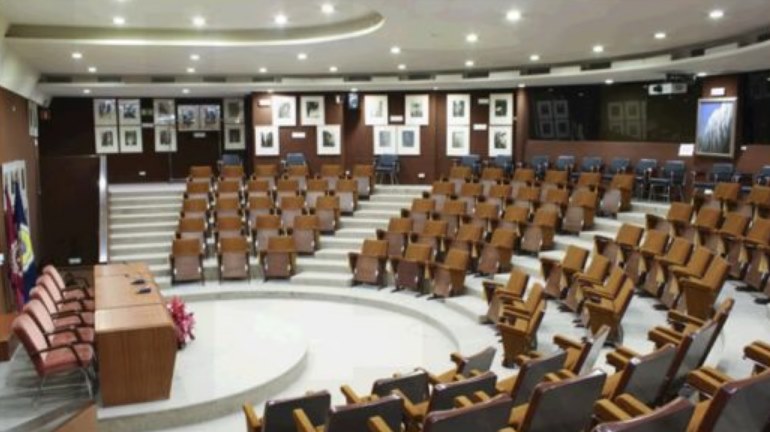
Date: Wednesday 11th December 2019. 09:00 - 13:00 Location: Fundación Gómez Pardo, Calle de Ríos Rosas 21, 28003 Madrid, Spain. Registration: The event is free. Registration is necessary. Important dates:
|
Abstract
IberLegal is a cross-sector, interactive workshop aiming at discussing advances of Natural Language Processing (NLP) in Legal data processing in languages of the Iberian Peninsula including Spanish, Spain’s co-official languages (Catalan, Basque, Galician) and Portuguese. Key players from Public Administration, Academia and Industry (NLP and Legal Industry) will share their perspectives, work in-progress and their experience in the field.
As such, it is conceived in the following specific objectives:
1) To discuss the needs and opportunities in the Legal domain within the context of the targeted languages.
2) To share results of concluded or on-going research work including language resources, NLP applications, Machine Translation, Dialogue Systems in the Legal domain;
3) To showcase current solutions and applications developed by the industry.
Target Groups for IberLegal
Scope of IberLegal
IberLegal takes into consideration two dimensions:
1- Dissemination for Plan TL focusing on Language Technologies in Justice/Legal Domain through an interactive discussion among representatives of the different sectors (Public Administration, Industry, Academia, Professionals, etc.) on needs, challenges and opportunities of NLP in the domain
2- Scientific Workshop for presenting results of ongoing work and research concerning HLT in the legal domain and in the Iberian languages.
Thus, we consider two types of participation:
- Short papers on results of ongoing or concluded research. The papers should present a summary of results previously published.
- Demos/showcases
Motivation behind IberLegal
Within the Spanish National Plan for the Advancement of Language Technologies (Plan TL), a number of specific priority domains are selected de develop pilot projects. The Legal domain is one of these priority areas that has been in the centre of the attention of Plan TL in the last two years, given its relevance and its impact on society at the different levels: governmental bodies, services for citizens, structural measures. Conversations were held at different levels with Public and Regional Administration as well as academic and industrial groups to gain first-hand insights on the current situation of NLP applied on Legal domain in the targeted languages.
From the organizers’ point of view, there are three main reasons are behind IberLegal. The first has to do with the institutional context and the role of Public Administrations; the second is related to the linguistic context and the third is concerned with the technical and practical use of NLP in the legal domain.
First and from the perspective of Plan TL, the Public Administration could promote the NLP industry and get more Public Administrations engaged into using the applications of NLP. Public Administrations could open more legal public datasets within the framework of the European Directive on open data and the re-use of public sector information, also known as the ‘Open Data Directive’ (Directive (EU) 2019/1024). Thus, providing necessary data and language resources for developing NLP-based components and intelligent solutions capable of: 1) transforming the lengthy traditional workflow of procedures into more effective and less-time consuming tasks; 2) assisting decision makers and public actors in navigating through the large amounts of legal data and retrieving the relevant information. Achieving this would result in better services for citizens.
Second, concerning IberLegal Languages, they represent, on one hand, two widely spoken languages: Spanish and Portuguese and, on the other hand, the three co-official languages in Spain, Catalan, Basque and Galician, considered as less-resourced languages from a NLP perspective. Despite the fact that Spanish language is one of the top internationally spoken languages with over than 500 million speakers, yet domain specific, well-curated, large-scale language resources for NLP are still limited compared to English. Same for Portuguese with over 200 million speakers. As per the co-official languages in Spain, Catalan, Basque and Galician, they are of great interest as a use case of less-resourced languages and, thus, advances on resources and applications are mostly welcome in the community of Human Language Technologies (HLT).
Third, the Legal Domain, including professionals in law firms, legislators and public administrators, handles vast amounts of legal data in different formats (text, audio and video). Intelligent solutions that are needed to extract relevant knowledge to facilitate daily tasks and to save time and effort. Introducing NLP techniques are crucial for a wide range of text-processing related applications such as information retrieval and extraction, entity linking, automatic summarization, inference, modeling, etc. In addition, Speech technologies could also play an important role in handling the multimodal data allowing more flexibility in navigating through the different formats and further facilities for professionals and the judicial sector to handle recordings of judicial acts or multimodal evidences. Accordingly, intelligent solutions applying NLP techniques would impact the sector qualitatively and quantitatively.
JURIX is one of the leading conferences in the domain. Taking the opportunity that this year it is held in Madrid, it is a perfect chance to promote more work in the legal domain in the Peninsular languages as well as to bring together the key players to discuss their needs, their challenges and the opportunities in the legal domain.
Organisers